A Pioneering Guitar Design by Francesco Molino

Panagiotis Poulopoulos is researching the development of a pioneering guitar design by Francesco Molino and its significance in guitar history.

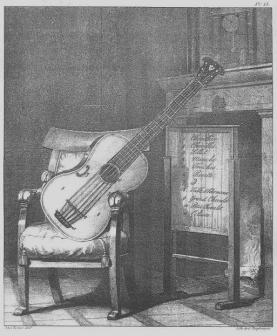
Francesco Molino (1768-1847) is known in the musicological literature as one of the most prolific and influential guitar players, teachers and composers of the early nineteenth century. What has not so far been thoroughly examined is his role in the invention around 1823 of a new type of guitar, described and depicted in some of his methods and evidenced by a number of surviving examples.

This guitar model had strong similarities with instruments of the violin family, especially those introduced in 1817 by François Chanot of Mirecourt. Moreover, it appeared almost simultaneously, if not before, with a kind of bowed guitar, now usually referred to as the ‘Arpeggione’, developed in the early 1820s in parallel by Johann Georg Stauffer in Vienna and Peter Teufelsdorfer in Budapest, as well as with the ‘Streichzither’, a bowed fretted zither conceived by Johann Petzmayer in Munich. Molino’s pioneering design may be of great importance in guitar history not only because it is one of the earliest attempts to introduce a guitar with violin features, and possibly predating the arpeggione, but also because it may have paved the way for the development of the archtop guitar in Europe and America in the beginning of the twentieth century.
molino_guitar

An illustration in Francesco Molino’s Grande Méthode Complète pour Guitare ou Lyre, op. 33 (Paris 1833) showing his pioneering guitar design. Image courtesy of Erik Stenstadvold.

This research project will examine Molino’s biography, focusing on his association to the guitar and the methods he published for the instrument. It will also present a historical and technical account of Molino’s guitar design, discussing in detail its main features as recorded in written sources, and as observed in iconography and extant specimens. Moreover, it will study how the instrument reflects Molino’s understanding of the guitar and his performance philosophy by extensively analysing the texts and illustrations in his methods. Furthermore, it will investigate the background behind the development of this experimental guitar, connecting it to the advances in science and technology, particularly in acoustics and engineering, which influenced the manufacture of musical instruments during the early nineteenth century. Finally, it will relate this innovative instrument to the social and intellectual environment as well as the musical context in which it appeared, illuminating the reasons why such an original instrument design did not become widely established in guitar circles.

The preliminary results of this research project were presented at the 2014 meeting of the Consortium for Guitar Research at Sidney Sussex College, University of Cambridge. Panagiotis Poulopoulos is currently collecting material and planning to publish a comprehensive article on the subject. Those wishing to share information on Molino and his experimental guitar design are welcome to contact him at: p.poulopoulos@deutsches-museum.de.
The Origins of the Guitar and Mandolin Duet

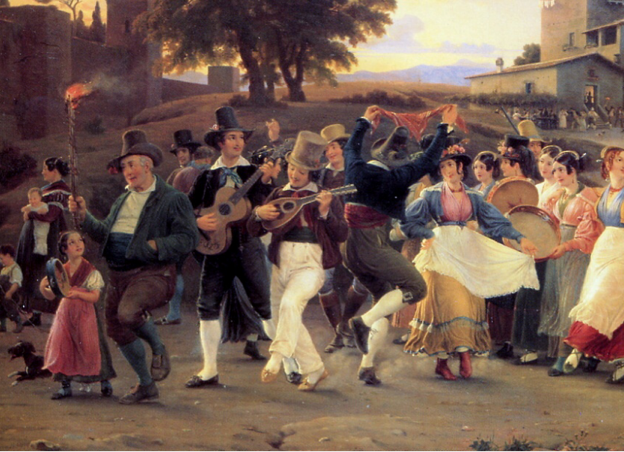
Paul Sparks is researching the origins of the mandolin and guitar duet. For centuries, these two instruments have formed a natural pairing, and it’s not hard to see why. They produce a roughly similar volume of sound, their combined range is equivalent to an early fortepiano, and the guitar’s harmonic potential and bass register makes it the ideal partner for the mandolin’s plectrum tremolo technique (which can sustain a melody effectively on double strings). Most compositions for mandolin also involve the guitar, and the two instruments are regularly combined into plucked string orchestras. Due to their portability, the pairing has historically been a central part of alfresco music making, especially in Italy, an association celebrated in such paintings as Wilhelm Martstrand’s “October Festival Evening outside the Walls of Rome” (1839), and in compositions by Verdi, Mahler, and Schoenberg.

Marstrand 1839

 As the history of both instruments (in their earliest forms) can be traced back to the sixteenth century, it might be expected that the pairing would also date from that time. Yet Paul’s research (conducted not just through printed and manuscript music, but also through method books, paintings, and the letters and diaries of travellers to the south of Europe) suggests that the mandolin and guitar were seldom, if ever, used together in duets until the start of the nineteenth century. During the C18, mandolinists favoured a harpsichord, cello, viol, or second mandolin to accompany their instrument when playing indoors, while street mandolinists in Italy were commonly partnered by a colascione or a violin, not by a guitar. The lack of a full bass register on the five-course guitar seems to have rendered it unsuitable, together with its comparative lack of volume when plucked with the fingers. For example, the C18 mandolin produced sufficient volume for opera composers such as Mozart, Grétry, and Paisiello to use it as an obbligato instrument, whereas the C18 guitar was never given in this role.

Continue reading

The guittar in Holland

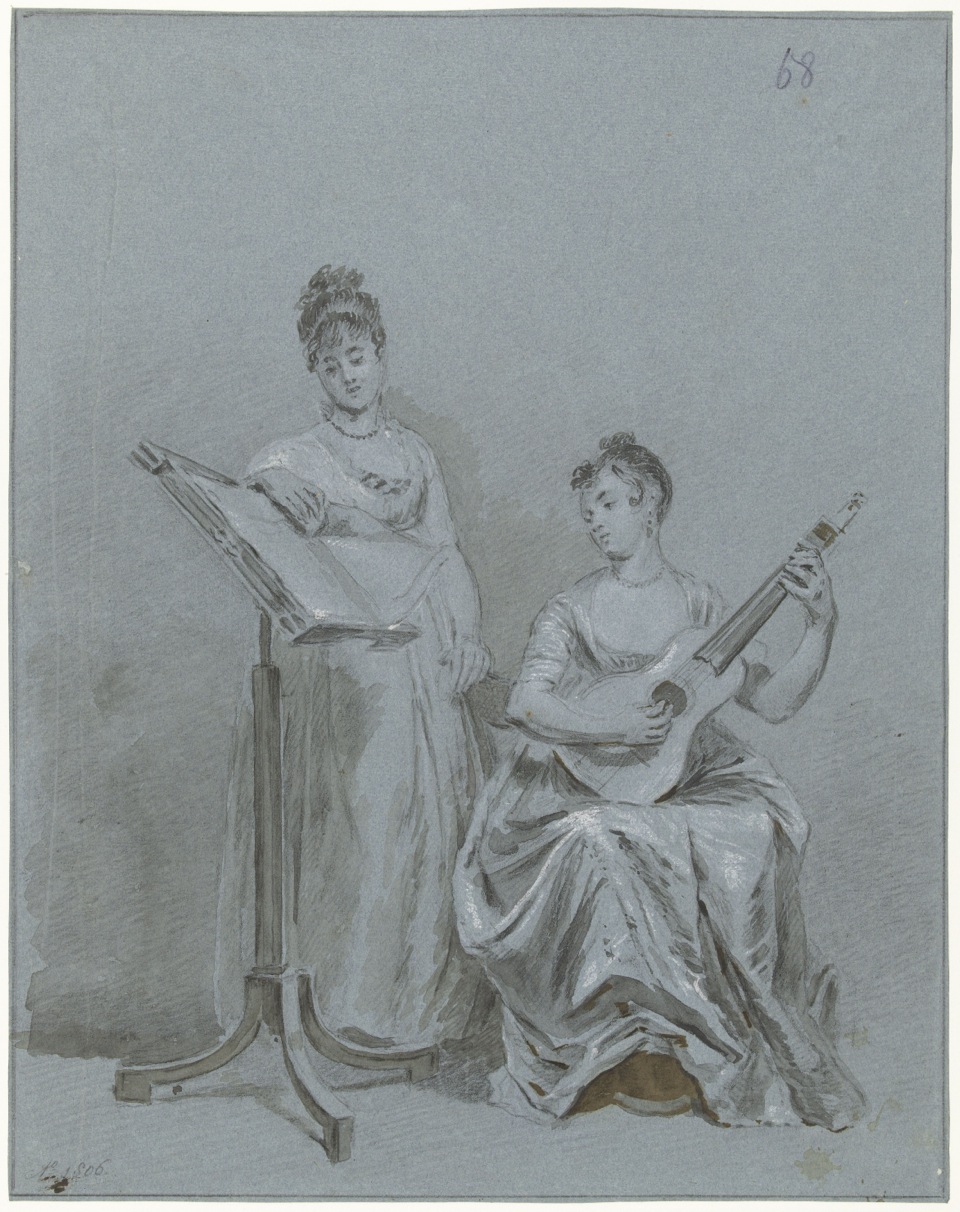
Jelma van Amersfoort is researching the use and the repertoire of the 18th century cittern in Holland. While its British counterpart, the English guittar, technically a six course wire-strung cittern, has received some welcome attention from scholars and performers in recent decades, its continental cousins have so far remained somewhat neglected. Wire-strung, finger played guittars appear to have been a far more European phenomenon than previously thought, with distinct but connected repertoires in France, the Low Countries, Italy and German-speaking nations. In the Netherlands, the ‘cistre’ or ‘Guitarre Angloise’, as it was called, proves to have had a small but surprisingly significant presence in Dutch culture: it appears in art and literature, was played in concerts, and had a number of compositions written for it.

RP-T-1890-A-2332(R)

Two ladies making music. Charles Edward Hodges, Den Haag 1806. Rijksmuseum, Amsterdam.

 Though the instrument was mainly associated in Holland with domestic music making by the upper classes, there are also records of it being played in the music room of Felix Meritis in Amsterdam and other public concert venues. English instruments and probably also instruments from Northern France were imported into Holland, but local luthiers also made them: various instruments by Johann Swartz and by Holland’s most famous violin maker, Johannes Cuypers, survive in museums and private collections.

In the 1770s the Amsterdam choirmaster David Leonardus van Dijk published four beautiful books of music for the instrument, filled with arrangements from very recent operas, guitar solos and guitar accompanied songs in French, Italian and English. These works appear to be all Van Dijk’s compositions and arrangements, influenced in style by contemporary cittern music from France and Britain, but never exact copies of works by others. The books reveal an internationalism that is somewhat reminiscent of Nicolas Vallet’s Secret des Muses for the lute 150 years earlier, with its comparable assimilation of international styles and themes for a favourite plucked instrument. The books also form a musical microcosm of some Dutch Enlightenment values: domesticity, openness to foreign influences and curiosity about the world.

Mariano de Castro

Mariano

Erik Stenstadvold is completing a study of a previously unknown guitarist,  Mariano de Castro.

With the aid of newspapers and other documents, Erik has reconstructed much of his career in various towns and cities of Britain.

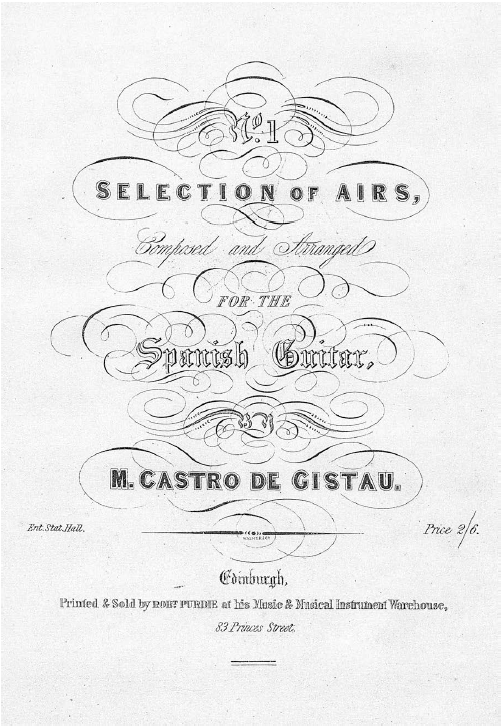
The guitar became widely fashionable in Britain in the second half of the 1820s, at a time when the instrument’s popularity was in decline on the continent. Consequently, a number of guitarists crossed the Channel in those years. Among these was a guitarist of Spanish-French background whose name and existence have hitherto been totally unknown: Mariano Castro de Gistau. This study reconstructs his biography from contemporary documents and newspaper accounts, and joins the growing body of work devoted to revealing the vogue for the ‘Spanish’ guitar in Britain during the early nineteenth century. It is also a case study of how a musician could make a career and livelihood in provincial Britain during that period. Mariano Castro arrived as a young man, probably in 1829, and stayed the rest of his life in Britain and Ireland until his death in 1856 in Cheltenham. He opted for a living outside of London (where he was only for a brief time), and was based during long periods in Edinburgh, Dublin, Aberdeen and Cheltenham. Contemporary concert reviews show that he was highly respected as an artiste. He appeared both as guitarist and singer (accompanying himself on the guitar), often accentuating the Spanish aspect of his performances. As for many musicians, teaching was a main source of his income. Advertisements show that, in addition to giving singing and guitar lessons, he was also a teacher of French and Spanish, and that he was engaged in various private schools and institutes, in particular after 1840 when those institutions became more common.

Nineteenth-century guitars at King’s College London

On Thursday 24 April, James Westbrook and Christopher Page took part in a seminar on nineteenth-century guitars as part of  Music in London 1800-1851, a five-year research project (2013-2018) funded by the European Research Council, based in the Music Department at King’s College London.

 http://www.kcl.ac.uk/artshums/depts/music/research/proj/mulondon/mulondon.aspx.

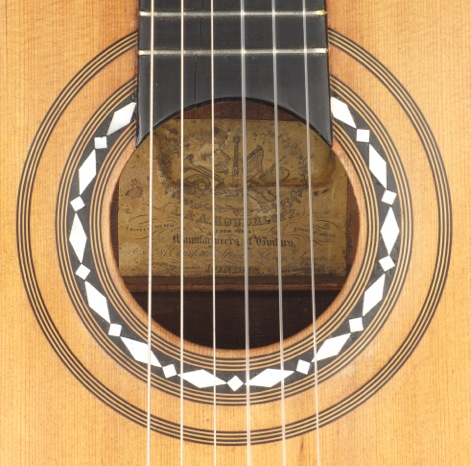
A Roudhloff x-braced Melophonic guitar of c. 1842 by Roudhloff, arguably the finest  achievement of  nineteenth-century guitar making in London.

Detail of a Roudhloff x-braced Melophonic guitar of c. 1842 by Roudhloff, arguably the finest achievement of nineteenth-century guitar making in London.

In attendance was a group a postdoctoral students working on the project, presided over by Professor Roger Parker. Most of the reading material comprised articles listed on this site, and written by members of the Consortium (see Publications) and there was lively discussion of many musical, social and organological issues. This was a valuable chance to make a bid for the place of guitars in a survey of unprecedented comprehensiveness

Welcome to our new website!

The Cambridge Consortium for Guitar Research is a society of guitar players and scholars devoted to the musical history, the social history and the organology of all Western instruments called ‘guitars’, but with special emphasis on the eighteenth and nineteenth centuries.

Please browse our sections to know more about us and our work, events, and publications.