Book reviews

Christopher Page’s new monograph:  The Guitar in Tudor England: a social and musical history, was described as ‘impeccably conceived, comprehensively researched and exquisitely written’ by John Milsom in his book review ‘Tudor books and guitars’ in Early Music, May 2016.

A review of the same tome in the North American journal Soundboard Scholar read: ‘What Christopher Page has penned […] is an elegant amalgam of social history and musicology mainly in one country. He makes creative and meticulous use of a wealth of the available research materials, many of them unique to England. He writes with elegance and insight, and provides an exhaustive bibliography. For anyone interested in building a library on the history of the guitar, this should be the essential first volume.’ Richard Long, Soundboard Scholar Volume 2, 2016.

The Consortium has a Patron

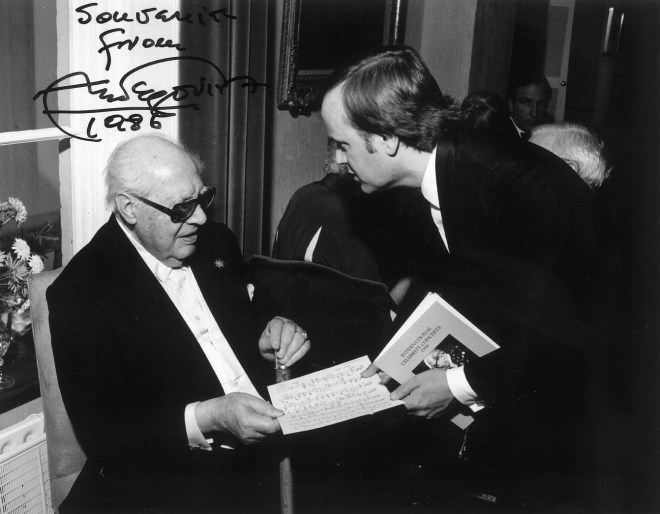
We are  delighted to announce that Brian Whitehouse has agreed to become the patron of the Consortium.  Brian is director of the Classical Guitar Centre in Birmingham.  He has had a long teaching career, having held appointments in the music departments at many of England’s universities and colleges. Recent publications are The Ramirez Collection – History and Romance of the Spanish Guitar and The Tárrega-Leckie Guitar Manuscripts –  Lessons with the Maestro. Currently in preparation is a further book and recordings relevant to Tárrega and Dr Leckie.

Brian Whitehouse with Andres Segovia in 1986.

Brian Whitehouse with Andres Segovia in 1986.

The 2016 Andrew Britton Fellow

To commemorate the sad loss of Andrew Britton, the members of the Consortium agreed to create an Andrew Britton Fellowship, the holder to be a young scholar working in the Consortiums field of interest and to have all accommodation and meals paid for attendance at the biennial colloquium. We are delighted to report that the first holder of the Fellowship was Dr. Vinciane Trancart of the University of Grenoble. Her 2014 Ph.D. (Foreign Languages and Literatures, La Sorbonne Nouvelle – Paris 3) was entitled “Harmony and Disharmony. Guitar Practices and Representations in Madrid and Andalusia from 1883 to 1922”. We were delighted to welcome Vinciane to the conference where she read an excellent paper. Details on the colloquium page.

The Fellowship for the 2018 Colloquium will be advertised in due course.

Dr. Vinciane Trancart

Dr. Vinciane Trancart

2016 Conference

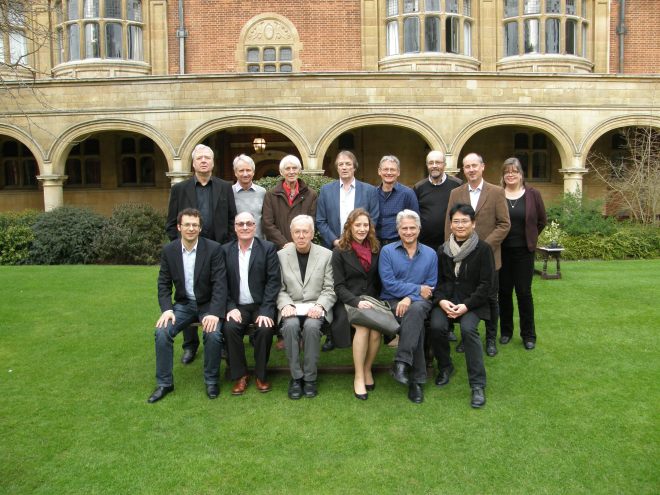
The 2016 biennial conference of the Guitar Consortium was held in Sidney Sussex College, Cambridge, from the 10-13 April, and was a great success. For the papers presented see the Colloquia page. Those attending were Thomas Heck, Jelma van Amersfoort, Brian Jeffery (Honorary Member), Gerhard Penn, Christopher Page, Panagiotis Pouloupolos, Richard Savino, Luis Briso de Montiano y Ruiz de la Sierra, Paul Sparks, Erik Stenstadvold, Taro Takeuchi, Vinciane Trancart (2016 Andrew Britton Fellow) Ulrich Wedemeier and James Westbrook.

At the business meeting which closed the conference, Gerhard Penn and Luis Briso de Montiano y Ruiz de la Sierra were unanimously elected as Ordinary Members.

Plans for publication of selected papers are afoot.

OLYMPUS DIGITAL CAMERA

Clara Ross

During 2017, Paul Sparks will be setting up a web site devoted to the life and music of Clara Ross (later Ross-Ricci, 1858-1954), a pioneering British female composer of music for mandolin and guitar, and leader of “Miss Clara Ross’ Ladies Mandoline and Guitar Band” during the 1890s. The site will include biographical information about the composer, a history of “ladies mandolin and guitar bands” in late Victorian and Edwardian Britain, and free downloads and recordings of Clara’s instrumental music for mandolin and guitar (and for mandolin and piano), as well as her songs for female voices with piano.

Dr James Westbrook receives the 2015 Terence Pamplin Award

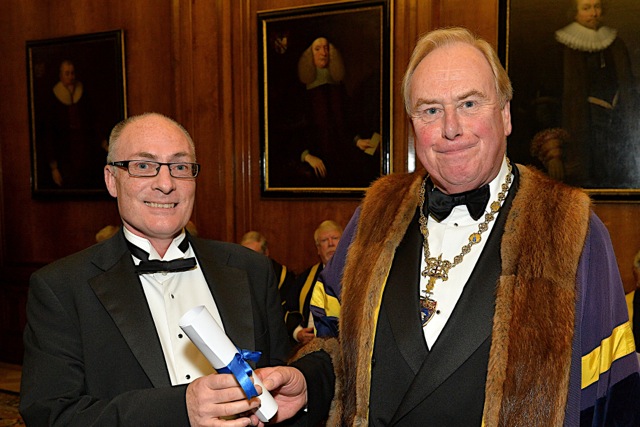
Dr James Westbrook has received the 2015 Terence Pamplin Award for Organology given by the Musicians’ Company. This biannual research prize of £1,200, is to assist further research into x-braced guitars by the Roudhloff Brothers and to make a replica instrument.
James receiving the award from the Master, Andrew Morris, at a Musicians’ Company banquet, at Merchant Taylors’ Hall, one of the great Livery Halls of the City of London  (photo: Peter Holland)

James receiving the award from the Master, Andrew Morris, at a Musicians’ Company banquet, at Merchant Taylors’ Hall, one of the great Livery Halls of the City of London  (photo: Peter Holland)

Arnold Myers, the Chairman of the judges said: “I am delighted that this year’s winner James Westbrook has been awarded the prize. Undoubtedly Terence Pamplin, in whose memory this award is made, would have approved. It is good to see that Cambridge is encouraging organological research and the award for the first time has gone to someone from other than London and Edinburgh.”

James received the cheque, and certificate, at a Musicians’ Company banquet, at Merchant Taylors’ Hall, one of the great Livery Halls of the City of London.

Andrew Britton: RIP

On a beautiful Autumn afternoon, the 14th October 2015, Andrew’s memorial service took place in the church where he worshipped as a boy. The church of St. Bartholomew, in a quiet suburb of Bristol, lies very close to where he was raised.

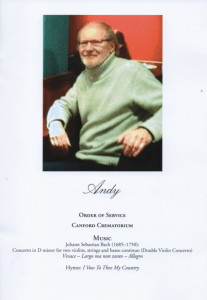
By two o’clock friends, family and colleagues had gathered to hear fond and loving reminiscences.Andrew BrittonThere were brief and affecting addresses by Andrew’s three sisters, another from his partner Judith and another from a lifelong friend. There were some hymns, a brief homily by the vicar on the theme of homecoming – taking the parable of The Prodigal Son as a text – and an accomplished performance of a piece by Sor (Op. 6, No. 9) given by another of Andrew’s many friends.

Those present learned a good deal about him from the various interventions: for example, that the little finger on his right hand was accidentally cut off by shears when he was a child and sewn back on (!), that he wrote his superb thesis longhand (scorning computers) in various Bristol cafés, and that his degree was in Scandinavian Studies with a special emphasis on Swedish. What came over most of all was the love and respect in which all present held his memory.

On the first page of the service booklet Judith used part of a larger photo of Andrew relaxing with members of the Consortium in Café Nero in Cambridge.

Fernando Sor on the move in the early 1820s

A new study of Sor by Erik Stenstadvold 

During his last months in London in 1822, Sor was busy composing music for the stage. The ballet Cendrillon was premiered at the King’s Theatre in March that year. Less known is that Sor was also involved in another scenic production, the five-hour long operatic drama, Gil Blas, which was premiered a few months later. Sor was partly responsible for the music. These works were mostly well received, but notwithstanding his success and the general recognition he had attained in London, Sor left Britain soon after. It has been generally assumed that the reason for his departure was the young ballerina Félicité Hullin, with whom he became romantically involved and who was invited to Moscow as prima ballerina in 1823. This study questions that assumption and presents two other possible causes that may have prompted Sor’s departure from England. Furthermore, it examines a previously unknown subsequent six months interim period in Paris during which he, with great success, appeared in a number of concerts in addition to preparing for the Paris premiere of Cendrillon in March 1823.  For details, see Publications page.

A Pioneering Guitar Design by Francesco Molino

Panagiotis Poulopoulos is researching the development of a pioneering guitar design by Francesco Molino and its significance in guitar history.

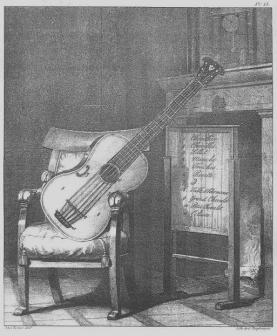
Francesco Molino (1768-1847) is known in the musicological literature as one of the most prolific and influential guitar players, teachers and composers of the early nineteenth century. What has not so far been thoroughly examined is his role in the invention around 1823 of a new type of guitar, described and depicted in some of his methods and evidenced by a number of surviving examples.

This guitar model had strong similarities with instruments of the violin family, especially those introduced in 1817 by François Chanot of Mirecourt. Moreover, it appeared almost simultaneously, if not before, with a kind of bowed guitar, now usually referred to as the ‘Arpeggione’, developed in the early 1820s in parallel by Johann Georg Stauffer in Vienna and Peter Teufelsdorfer in Budapest, as well as with the ‘Streichzither’, a bowed fretted zither conceived by Johann Petzmayer in Munich. Molino’s pioneering design may be of great importance in guitar history not only because it is one of the earliest attempts to introduce a guitar with violin features, and possibly predating the arpeggione, but also because it may have paved the way for the development of the archtop guitar in Europe and America in the beginning of the twentieth century.
molino_guitar

An illustration in Francesco Molino’s Grande Méthode Complète pour Guitare ou Lyre, op. 33 (Paris 1833) showing his pioneering guitar design. Image courtesy of Erik Stenstadvold.

This research project will examine Molino’s biography, focusing on his association to the guitar and the methods he published for the instrument. It will also present a historical and technical account of Molino’s guitar design, discussing in detail its main features as recorded in written sources, and as observed in iconography and extant specimens. Moreover, it will study how the instrument reflects Molino’s understanding of the guitar and his performance philosophy by extensively analysing the texts and illustrations in his methods. Furthermore, it will investigate the background behind the development of this experimental guitar, connecting it to the advances in science and technology, particularly in acoustics and engineering, which influenced the manufacture of musical instruments during the early nineteenth century. Finally, it will relate this innovative instrument to the social and intellectual environment as well as the musical context in which it appeared, illuminating the reasons why such an original instrument design did not become widely established in guitar circles.

The preliminary results of this research project were presented at the 2014 meeting of the Consortium for Guitar Research at Sidney Sussex College, University of Cambridge. Panagiotis Poulopoulos is currently collecting material and planning to publish a comprehensive article on the subject. Those wishing to share information on Molino and his experimental guitar design are welcome to contact him at: p.poulopoulos@deutsches-museum.de.